Google Maps in Oakland, CA: Get Your Business Found Near 2525 Oliver Ave
Expand Your Google Maps Coverage. Get Found in More Local Searches.

What's Covered on This Page
- Signs Your Google Business Profile Is Losing the Map Pack
- How Google Ranks Local Businesses on Maps
- When Google Maps Isn't the Right Fix for Your Business
- What Happens During a Google Maps Audit and Buildout
- Reviews and Response Habits That Keep Rankings From Sliding
- How do I know if my Oakland business is losing the Map Pack?
- What happens during a Google Maps audit for my Oakland business?
- Why does my business near Oliver Ave have a duplicate Google listing?
- How does Google decide which Oakland businesses rank on Maps?
- Is Google Maps SEO the right next step for my business?
- Which Oakland neighborhoods affect my Google Maps search results?
Signs Your Google Business Profile Is Losing the Map Pack
Quick Summary: If your Oakland business has quietly vanished from the Map Pack, the cause is usually visible once you know where to look. Watch for missing rankings on core service plus city searches, newer competitors suddenly outranking you, duplicate listings from a prior tenant, or an incorrect business category buried in your profile settings.
Before assuming Google is broken, run a simple gut check. Search your main service paired with Oakland. Then check nearby neighborhoods like Fruitvale, Temescal, or West Oakland, where 2525 Oliver Ave sits. If your business doesn't appear in the top three Map Pack results for these searches, something structural is working against you. It's not just a temporary algorithm shift.

- You no longer show up for your core service plus city term, even when searching from a device physically located near your storefront
- A competitor that opened after you now consistently outranks your listing despite having fewer reviews
- Customers mention finding two different listings for your business, sometimes with different phone numbers or hours
- Your profile is categorized under a generic or incorrect primary category that doesn't match what customers search for
- Review counts seem lower than expected because feedback is scattered across multiple profile versions
Oakland's building stock creates a local wrinkle that flatlines many otherwise solid profiles. Neighborhoods like Fruitvale and pockets of East Oakland are full of older commercial buildings and converted storefronts that have changed hands multiple times. When a new business moves into a space, Google sometimes keeps the prior tenant's listing active or half-merged with the new one. This creates a duplicate that splits reviews, confuses the algorithm, and dilutes ranking signals between two competing profiles for the same address.
This duplication problem is easy to miss. The old listing often shows as closed or permanently inactive in a normal search. Yet it still exists in Google's index and continues absorbing map data tied to your physical location. A quick way to check is searching your exact address rather than your business name. This frequently surfaces forgotten listings from a laundromat, salon, or auto shop that operated in the space years earlier.
How Google Ranks Local Businesses on Maps
Here's the thing most business owners get wrong. Google doesn't rank businesses by how good they are. It ranks them by three signals: relevance, distance, and prominence. That's it. No secret formula, no magic switch.
Relevance means your Google Business Profile matches what someone typed. Distance means how close you are to the searcher, or to the area you've told Google you serve. Prominence covers everything else: your reviews, your citations, your website, how well-known you are online.
- Relevance: your business category, services, and profile details match the search term
- Distance: your location or service area lines up with where the person is searching from
- Prominence: your review count, review quality, and overall online presence signal trust
This is why a plumber near Lake Merritt can outrank a plumber near the Oakland Zoo for a search done in Rockridge, even if the zoo-area plumber has better reviews. Distance carries real weight. A search from Fruitvale pulls a different set of results than the same search from Temescal, because Google treats each searcher's location as its own map.
We've pulled Maps rankings for contractors where the profile looked fine on the surface. We found wrong categories, no service area set, and prominence stuck at a handful of old reviews. Fix one piece and nothing moves. Fix all three, that's when the map pack starts filling in.
So the real question isn't 'why don't I rank.' It's which of the three signals is broken.
When Google Maps Isn't the Right Fix for Your Business
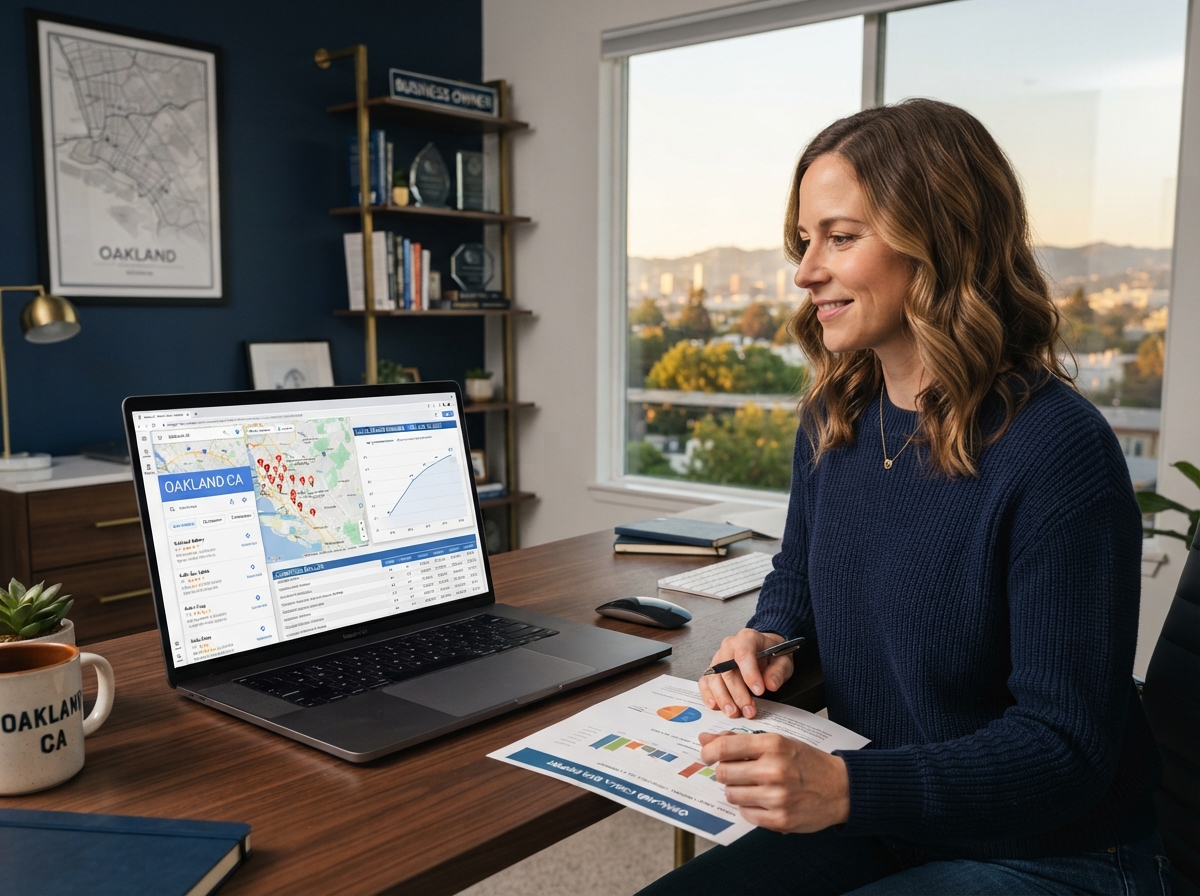
Not every business needs this right now. Here's the truth.
If your Google Business Profile isn't even claimed yet, or it's missing basic info like hours and service categories, Maps work is getting ahead of itself. We see this every week. A contractor calls wanting to rank higher, but their profile has three photos and no posts since 2021. Fix the foundation first. The same goes if you've got fewer than five reviews total. Ranking work built on a thin profile doesn't hold. Customers click through and bounce because there's nothing there to trust.
If your website is broken, slow, or missing basic contact info, that's a website problem, not a Maps visibility problem. Getting found is one thing. Converting that click into a call is another. No amount of Maps work fixes a site that doesn't load on a phone.
And if you're a new business with zero track record, zero reviews, and no completed jobs in Oakland yet, wait. Google needs signals to trust. There's nothing to optimize yet; there's only time and real customer activity to build first.
One more case: if you already show up in the top three for your main terms across most of your service area, and your review flow is steady, you may not need a full overhaul. You might just need maintenance, not a rebuild.
So before you spend money chasing rankings, ask yourself whether the basics are in place.
Thinking about Google Maps SEO in Oakland, CA? Let's talk.
Get My Free Maps Scan. Thompson-SEO-Experts is ready to help.
What Happens During a Google Maps Audit and Buildout
Before any changes go live, a proper Google Maps engagement starts with a full diagnostic. Working from an Oakland-based vantage point near 2525 Oliver Ave, the process looks at how a business currently shows up for buyers searching in West Oakland, the Golden Gate district, and surrounding zip codes. Then it builds a system to fix what is broken and reinforce what already works.
- Audit: Every existing asset gets pulled apart. This includes the Google Business Profile categories and attributes, website structure and page speed, review volume and sentiment across Google and Yelp, and current keyword rankings for map pack terms like 'plumber near me' or 'Oakland auto repair.'
- Identify gaps: The audit findings are compared against top-ranking competitors in the same Oakland map pack to pinpoint missing photos, thin service pages, inconsistent posting activity, or slow response times to reviews that are costing visibility and phone calls.
- Implement: Tailored fixes go live. These include category corrections, geo-relevant service area settings, structured photo uploads, review response workflows, and on-site schema markup that ties the business to its actual Oakland service radius.
- Track: Rankings, call tracking numbers, direction requests, and website inquiries are monitored weekly so the buildout can be adjusted based on real performance data rather than guesswork.
A step that gets overlooked by many DIY approaches is confirming the business name and address match public records exactly. In Oakland, that means cross-checking the Google Business Profile against the City of Oakland Business Tax Certificate on file. Discrepancies between a storefront's registered name or suite number and what appears online can quietly suppress rankings or trigger profile suspensions.
Reviews and Response Habits That Keep Rankings From Sliding

A lot of Oakland businesses treat reviews like a one-time push. They ask every customer for two weeks after opening, hit forty or fifty reviews, then move on. That approach explains why so many well-reviewed shops near the Prescott and Hoover-Foster areas still plateau on the map. Google doesn't just count stars; it watches velocity, recency, and whether the business owner is engaged. A profile with 60 reviews from two years ago reads differently to Google's systems than one with 60 reviews where 15 came in the last quarter and every one got a specific, thoughtful reply.
Response habits matter because they're one of the few prominence signals a business controls directly and continuously. Unlike a citation, which you fix once and largely forget, review responses are a weekly or biweekly task. A business near Oliver Ave that responds to a review mentioning 'fast turnaround on cabinet repairs' is reinforcing service and location context. This echoes the same keywords living in its Business Profile description and citations. This is where reviews stop being a reputation exercise and start functioning as part of the same relevance system as category selection and NAP consistency.
- Respond within a few days, not weeks. Response lag itself appears to correlate with reduced engagement signals.
- Mention the service or product in replies, not just 'thank you.' Responses reinforce the same terms used in the business description and posts.
- Address negative reviews specifically and factually. Ignored complaints tend to sit on profiles that also show weaker overall engagement.
- Keep a steady cadence of new reviews rather than bursts followed by silence. Flatlined review counts often coincide with stalled rankings.
- Cross-check that reviewer-mentioned services match the categories and attributes set on the profile, closing gaps between what customers say and what Google reads.
None of this produces an overnight jump. The businesses that hold steady positions on the map near Oliver Ave and throughout Oakland tend to be the ones treating reviews as a recurring habit. This compounds alongside citation cleanup and category audits, not a separate marketing task. Skipping responses for a month or two doesn't usually cause a visible drop right away. But it slowly removes one of the few consistent freshness signals feeding the profile. That's often when a plateau turns into a slide.
Frequently Asked Questions
Common questions about Google Maps SEO in Oakland, CA
How do I know if my Oakland business is losing the Map Pack?
The clearest sign is when your core service plus city search stops showing your listing in the top three results. Check this from a device near your storefront first. Then look for newer competitors outranking you despite fewer reviews, or customers mentioning two different listings with different phone numbers. If your profile sits under a generic category that doesn't match what people search, that's another red flag worth checking today.
What happens during a Google Maps audit for my Oakland business?
A proper audit starts with a full diagnostic of how your business currently shows up for buyers searching from West Oakland, the Golden Gate district, and nearby zip codes. We check your category accuracy, service area settings, and review signals before touching anything live. This tells us which of the three ranking factors, relevance, distance, or prominence, is holding you back. Call now to get a free Maps scan and see where your listing stands.
Why does my business near Oliver Ave have a duplicate Google listing?
This happens a lot in Fruitvale and pockets of East Oakland because older commercial buildings change tenants often. When a new business moves in, Google sometimes keeps the prior tenant's listing half-active instead of fully closing it. This splits your reviews and confuses ranking signals for the same address. Search your exact street address instead of your business name to check for a forgotten listing from a past laundromat, salon, or shop still absorbing your map data.
How does Google decide which Oakland businesses rank on Maps?
Google ranks by three signals only: relevance, distance, and prominence. Relevance means your profile matches the search term. Distance means how close you are to the searcher or your stated service area. Prominence covers your reviews and overall online presence. This is why a business near Lake Merritt can outrank one near the Oakland Zoo for a search done in Rockridge. Fixing just one signal rarely moves the needle. All three need attention together.
Is Google Maps SEO the right next step for my business?
Not always, and it's worth checking first. If your Google Business Profile isn't even claimed, has no recent photos, or you have fewer than five total reviews, fix that foundation before chasing rankings. A broken or slow website is also a different problem than Maps visibility. New businesses with zero completed jobs in Oakland need time to build trust signals first. If you already rank top three for your main terms with steady reviews, you likely need maintenance, not a rebuild.
Which Oakland neighborhoods affect my Google Maps search results?
Nearby areas like Fruitvale, Temescal, and West Oakland each pull separate search results because Google treats every searcher's location as its own map. A search from Fruitvale shows different Map Pack results than the same search from Temescal, even for identical service terms. This matters if you serve a wide area. Checking rankings from multiple neighborhoods, not just your own street, gives you a truer picture of your actual visibility across Oakland.
Ready to Get Started?
Get My Free Maps Scan. Call (408) 439-9589 today.
Related Services
Local SEO
Local SEO helps your Oakland business show up when nearby customers search for what you do — in Google Search, in Google...
Learn moreGoogle Business Profile Optimization
Your Google Business Profile is often the first thing a customer sees when they search for you. We optimize it to appear...
Learn moreLocal Citation Building
Local citations — your business name, address, and phone number listed across directories — are a core local SEO signal....
Learn more