Email Marketing in Oakland, CA: Turn a Dormant Customer List Into Repeat Business
Expand Your Google Maps Coverage. Get Found in More Local Searches.

What's Covered on This Page
- Signs Your Customer List Needs an Email Marketing System
- What Happens During an Email Marketing Audit
- How Email Marketing Connects to SMS, Reviews, and List Reactivation
- Compliance Rules for Emailing Your Oakland Customer List
- When Email Marketing Isn't the Right Fit Yet
- How quickly can you get an email marketing system set up for my business?
- What happens during the first email marketing audit?
- Why do homeowners near Golf Links Road and Skyline Boulevard need follow-up emails after a quote?
- My customer list hasn't been touched in over a year. Is it too late to fix?
- Does email marketing work on its own, or do I need texting and reviews too?
- How do you handle a customer list that mixes old customers, one-time leads, and vendors together?
Signs Your Customer List Needs an Email Marketing System
Quick Summary: If your customer list lives in a dusty spreadsheet or a CRM you rarely open, you're leaving money on the table every month. Businesses around the 94605 hills near Knowland Park and the Oakland Zoo often collect hundreds of contacts from quotes and service calls but never follow up systematically. An audit-first email system turns that dormant list into a steady source of repeat and referral business.
Many independent contractors, landscapers, and home-service providers working the winding streets around Golf Links Road and Skyline Boulevard have built customer lists for years without realizing how stale they are. If you can't remember the last time you emailed your full list, or if half your contacts would be surprised to hear from you, that's the first red flag. A list that only gets touched during tax season or slow months isn't a marketing asset; it's digital clutter.

Another sign is what happens after you send a quote. In service-heavy neighborhoods near Knowland Park, homeowners often request multiple estimates for roofing, tree removal, or fencing before deciding. If your process ends at 'we sent the quote' with no automated nurture sequence, you're losing winnable jobs to competitors who follow up with helpful reminders, project photos, or seasonal offers.
- You send emails only when business is slow, with no consistent schedule or theme
- Your list mixes old customers, one-time leads, and vendors with no segmentation
- You have no idea what your open or click rates are, or if the list even delivers
- Quotes and estimates go out but there's no automatic follow-up sequence afterward
- Your CRM or spreadsheet hasn't been cleaned or updated in over a year
- Repeat customers near the zoo or hills area don't hear from you between service calls
These patterns point to the same underlying issue: a list without a system. One-off blasts sent in a panic rarely convert because they lack context, timing, and personalization. Foothill-area businesses need an audit-first approach that inventories existing contacts, identifies dead weight, and connects the list to a real workflow tied to quotes, jobs, and follow-ups.
What Happens During an Email Marketing Audit
What does an audit look like? Not a form letter. Not a generic checklist pulled off the internet. We sit down with your customer list, your past campaigns if you have any, and your website's lead capture points. Often, the list itself is the problem. Old contacts, no segmentation, no clear reason for someone to open the email in the first place.
- We review your current customer list for size, quality, and how it was collected
- We check whether your website and Google Business Profile capture emails from visitors
- We look at past campaigns, if any exist, for open rates and click patterns
- We identify gaps where leads go cold after the first contact
- We map out where email fits with your other tools, like missed-call text back or SMS marketing
Most business owners miss this part. Email marketing doesn't work alone. It works best paired with customer list reactivation, so the names sitting dormant in your system finally get a reason to respond. A contractor might have three hundred past customers who never got a follow-up. That's not a small list problem; it's a missed revenue channel.
We'll tell you straight if your list isn't ready yet. Sending to fifty stale addresses won't move the needle, and we're not going to pretend it will.
How Email Marketing Connects to SMS, Reviews, and List Reactivation
A business operating in Oakland doesn't win customers through email alone. Local shoppers move between channels constantly: they get a text confirmation, check reviews on their phone before walking in, and open a promotional email later that evening. Treating email as an isolated silo ignores how customers behave. The businesses that retain the most customers build a connected system where email, SMS, review requests, and missed-call text-back all reinforce each other.
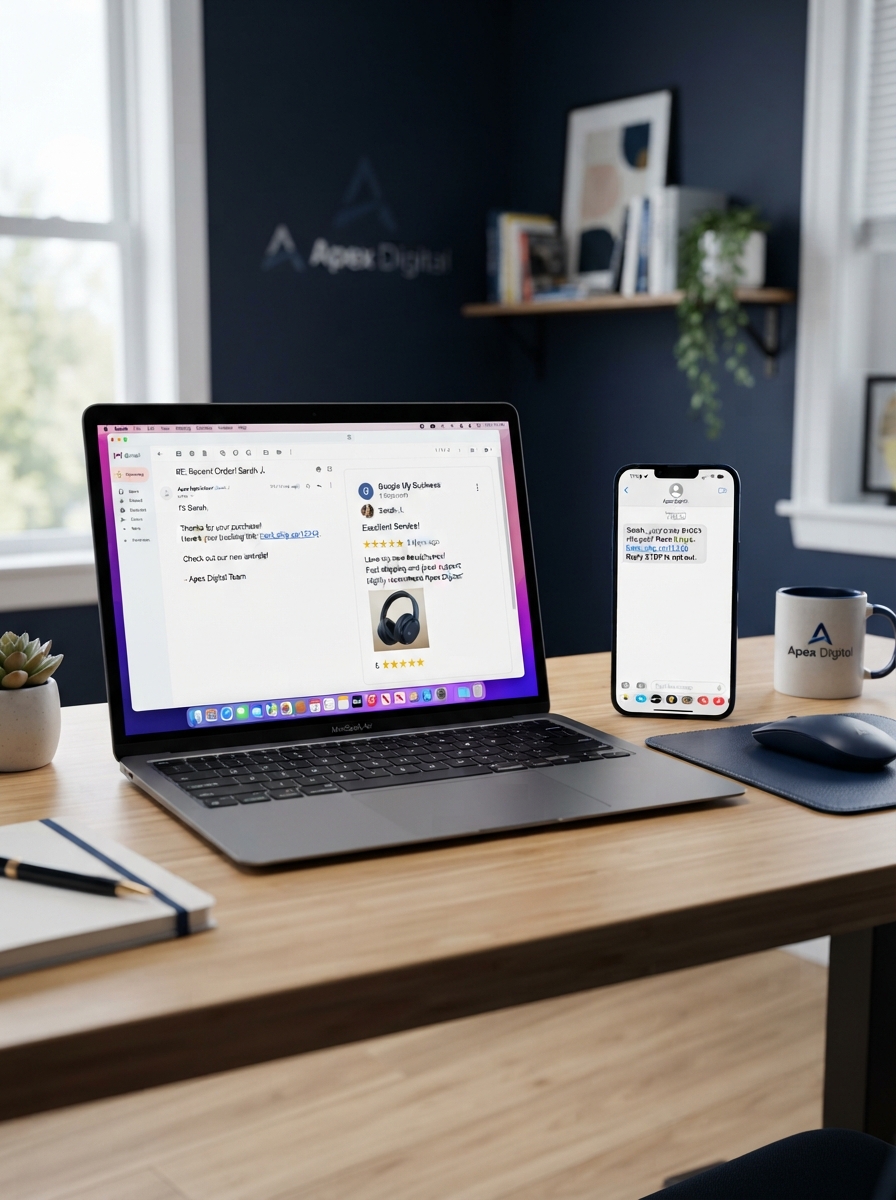
A welcome sequence is a good example of this overlap. When a new customer signs up in-store or online, the first email might introduce the business and set expectations. A same-day SMS confirms an appointment or thanks them for a purchase. That combination increases open rates and response rates more than either channel used alone, because customers see consistent, timely messaging across the two places they check most.
Reactivation campaigns work the same way. A dormant customer who hasn't opened emails in six months might still answer a text. Pairing a re-engagement email with a follow-up SMS, and layering in a review request once they return, creates multiple touchpoints that recover revenue a single email blast would miss entirely.
Review requests deserve the same coordinated approach. Sending a review ask by email a week after service, then following with a short SMS reminder for those who haven't responded, consistently produces more reviews than either channel alone. More reviews mean stronger local visibility, which feeds new customers back into the same email and SMS system.
Building this kind of system isn't guesswork. It follows a four-step process: first, an audit of existing email, SMS, and review workflows to see what's currently happening. Second, identifying gaps, such as no missed-call text-back or a welcome sequence that stops after one email. Third, implementing tailored systems that connect these channels based on the business's actual customer flow, not a generic template. Fourth, tracking results such as reactivation rate, review volume, and response times, then adjusting based on what the data shows.
Have questions? We're happy to help.
Get My Free Maps Scan. Thompson-SEO-Experts is ready to help.
Compliance Rules for Emailing Your Oakland Customer List
Nobody tells you this when you start emailing customers: the rules aren't complicated, but skipping them will tank your results fast. The federal CAN-SPAM Act sets the baseline for any business sending commercial email, and it applies to you whether you've got 50 contacts or 5,000.
We see this every week with new clients. They've got a list sitting in a spreadsheet, never touched it, and worry it's too risky to use. Usually it's fine; it just needs cleanup first.
- Every email needs a working unsubscribe link, and honoring it fast matters
- Your subject line has to match what's inside the email
- You need a real business name and address somewhere in the message
- Never buy a list, only email people who gave you their address
- Old contacts who haven't opened anything in over a year should get a re-engagement push or get removed
That last point is where Customer List Reactivation comes in. Before you blast an old list, you clean it, warm it back up, then start sending. Skip that step and you'll see spam complaints climb, your open rates drop, and inbox providers start filtering you out entirely.
Not sure if your list is even usable anymore? That's more common than you'd think.
So keep it simple. Permission first, honesty in every subject line, an easy way out for anyone who wants off the list. Do that, and you're covered.
When Email Marketing Isn't the Right Fit Yet
Not every business in Oakland needs a managed email program, and pretending otherwise would undercut the whole point of recommending an audit first. If your contact list is small, say under fifty names, and your business model doesn't depend on repeat visits or seasonal reminders, a paid strategist is overkill right now.

Think about a one-time home renovation contractor who gets referrals rather than repeat jobs, or a pop-up vendor collecting emails at a single neighborhood market. These businesses can sign up for a free tier of Mailchimp, MailerLite, or a similar tool, write a simple monthly update, and get real value without spending a dollar on outside help.
- You have fewer than 100 contacts and no clear plan to grow that list quickly
- Customers rarely return for a second purchase or service call
- You send at most one or two emails a month with no segmented audiences
- You are comfortable using a template editor and don't need custom automations
- Compliance concerns are minimal because you're not collecting sensitive data or running large campaigns
The calculation changes once your list grows past a few hundred contacts, especially if those contacts fall into different categories, like past customers, active clients, and cold leads, that each need a different message. That's when segmentation starts eating real hours every week. Automation sequences, like a welcome series for new sign-ups or a re-engagement flow for lapsed customers, also take setup time and testing that most owners can't spare between running the actual business.
Compliance is the other trigger point. Once you're sending regularly to a list that includes both individual consumers and business contacts, CAN-SPAM requirements around unsubscribe handling, sender identification, and list hygiene stop being a once-and-done checkbox and become an ongoing responsibility. Getting it wrong risks deliverability problems and complaints, not just fines.
We'd rather tell a business that they're not ready than sign them up for services they don't need. That's why the audit-first approach described elsewhere on this page exists: it looks at your actual list size, sending habits, and compliance exposure before recommending anything, so you only pay for help once it will genuinely save you time or protect your business.
Frequently Asked Questions
Common questions about Email Marketing in Oakland, CA
How quickly can you get an email marketing system set up for my business?
We start with an audit of your current list, usually within the first week of your call. This lets us see how many contacts you have and whether your website is even capturing new emails. Businesses near Knowland Park and the Oakland Zoo often have hundreds of old quote contacts sitting unused. Once we know what we're working with, we build the actual workflow, like follow-up sequences after a quote, so your list starts working instead of just sitting there.
What happens during the first email marketing audit?
We sit down with your actual customer list, not a generic checklist. We check the size and quality of your contacts, look at whether your website and Google Business Profile collect emails, and review any past campaigns for open rates. We also look for gaps where leads go cold after the first quote. If your list has fifty stale addresses, we'll tell you that straight instead of pretending a campaign will fix it.
Why do homeowners near Golf Links Road and Skyline Boulevard need follow-up emails after a quote?
Because homeowners in that area often collect several estimates before choosing a contractor. If your process stops at 'we sent the quote,' you lose winnable jobs to competitors who follow up with reminders or project photos. An automatic nurture sequence keeps your name in front of the customer while they compare options, instead of letting your quote disappear into their inbox.
My customer list hasn't been touched in over a year. Is it too late to fix?
No, but it needs an audit before you send anything. A list that only gets emailed during slow months isn't a marketing tool, it's clutter. We review what's in there, remove dead weight, and connect the remaining contacts to a real workflow tied to your quotes and jobs. Sending one panic blast to an old list rarely works, but a cleaned-up list paired with a proper sequence often turns into repeat business fast.
Does email marketing work on its own, or do I need texting and reviews too?
Email works best paired with SMS and review requests, not alone. Customers in Oakland move between checking texts, reading reviews, and opening emails, often in the same day. A welcome email paired with a same-day confirmation text gets more responses than either one by itself. Pairing a reactivation email with a follow-up text also recovers customers a single email would miss.
How do you handle a customer list that mixes old customers, one-time leads, and vendors together?
We separate them into groups before sending anything. Mixed lists with no segmentation are one of the biggest reasons emails get ignored or marked as spam. Once we know who's a repeat customer, a one-time lead, or a vendor, we can send messages that match what each group needs. That's usually the step that turns a dusty spreadsheet into a working system.
Ready to Get Started?
Get My Free Maps Scan. Call (408) 439-9589 today.
Related Services
SMS Marketing
Text messages have a 98% open rate. For Oakland service businesses, SMS marketing is one of the most direct, immediate w...
Learn moreCustomer List Reactivation
Your past customers are your most profitable leads. They already know you, trust you, and have experienced your work. We...
Learn moreReputation Management
Your online reputation is your most visible marketing asset. We help Oakland businesses monitor, build, and protect thei...
Learn more